

The milestone that changes everything
Breaking 100 is one of the most satisfying achievements in golf. It signals that you have moved beyond the survival stage and into the realm of genuine, enjoyable golf. Yet so many players hover in the low 100s for months — sometimes years — convinced that the answer lies in a longer drive or a new set of irons.
It rarely does. The path from 105 to 99 is paved not with better swings but with better decisions. This guide will show you exactly how to shave those stubborn strokes by thinking differently about every hole you play.
Change your target: play for bogey, not par
Here is the single most liberating idea in this entire article: you do not need a single par to break 100. Eighteen bogeys give you a score of 90 on most courses. That means you can make eighteen bogeys, throw in a few double bogeys, and still come in under the century mark with room to spare.
When you accept bogey as your target score, the entire game shifts. A par four is no longer a drive-and-iron challenge — it becomes a comfortable three-shot hole. A 200-yard par three does not demand a perfect long iron; it asks for two easy shots and a putt. This mental reframe removes the pressure that causes rushed swings, hero shots, and the big numbers that wreck scorecards.
Write this on a card and keep it in your bag: my goal on every hole is bogey. Every par is a bonus. Every double bogey is still survivable. The round-killers are the triples and worse, and those almost always come from trying to do something the situation does not require.
Course management: the art of staying out of trouble
Tour professionals think about where they do not want to miss. You should do the same, only with even more caution. Before every shot, ask yourself one question: what is the worst thing that can happen if I miss this? If the answer involves water, out of bounds, dense trees, or a deep bunker, choose a different target.
Off the tee
You do not need to hit driver on every par four and five. If driver regularly puts you in trouble, try a hybrid or even a long iron. A shot that travels 180 yards into the middle of the fairway is vastly more valuable than one that flies 240 yards into the woods. From the fairway you have options. From the trees you have damage control.
On tight holes, aim for the widest part of the fairway, even if it adds a few yards to your approach. On doglegs, play to the corner rather than trying to cut it. Safe and in play beats bold and buried every time.
Approach shots
When playing your second or third shot into a green, aim for the centre. Forget about flag hunting. Most pins are tucked near bunkers, slopes, or edges precisely to tempt you into risky plays. The middle of the green gives you the largest margin for error and almost always leaves a manageable putt or chip.
If you are more than 160 yards from the green, seriously consider laying up to your favourite yardage instead of going for it. A comfortable wedge from 80 yards will get you closer to the hole more often than a strained five iron from 180.
Trouble shots
When you do find trouble — and you will — take your medicine immediately. Punch sideways out of the trees. Drop from the hazard and play on. Do not compound one bad shot with another by attempting a miracle recovery through a gap the size of a letterbox. The fastest way back to bogey is the simplest route back to open grass.
Club selection strategy: know your real distances
Most golfers overestimate how far they hit each club by 10 to 20 yards. They remember their best strike with a seven iron and call that their seven-iron distance, ignoring the eight other shots that fell short. Be honest with yourself. If your seven iron usually travels 140 yards, that is your seven-iron distance, regardless of the one time it flew 155.
Spend one range session hitting ten balls with each club and noting where the majority land — not the longest, not the shortest, but the cluster in the middle. Write those numbers down. Use them on the course. When you are between clubs, take the longer one and swing smoothly rather than forcing the shorter one. Smooth swings produce straighter shots, and straight matters far more than long when you are chasing 99.
Build your bag around reliability. Identify the three or four clubs you hit most consistently and lean on them. If you cannot hit your three iron but your five hybrid is dependable, leave the three iron at home. Nobody on the course is checking which clubs are in your bag.
The short game: where the real strokes are saved
If there is one area that separates a 105 golfer from a 95 golfer, it is the short game. Getting up and down — chipping onto the green and one-putting — even a few times per round can save you four to six strokes without changing a single full swing.
Chipping
Pick one club for most of your chips around the green. An eight iron or pitching wedge works beautifully for bump-and-run shots. Keep the ball low, let it roll to the hole, and focus on landing it on the green rather than flying it all the way to the pin. A chip that rolls past the hole by ten feet is still better than a fluffed lob that stays in the rough.
Putting
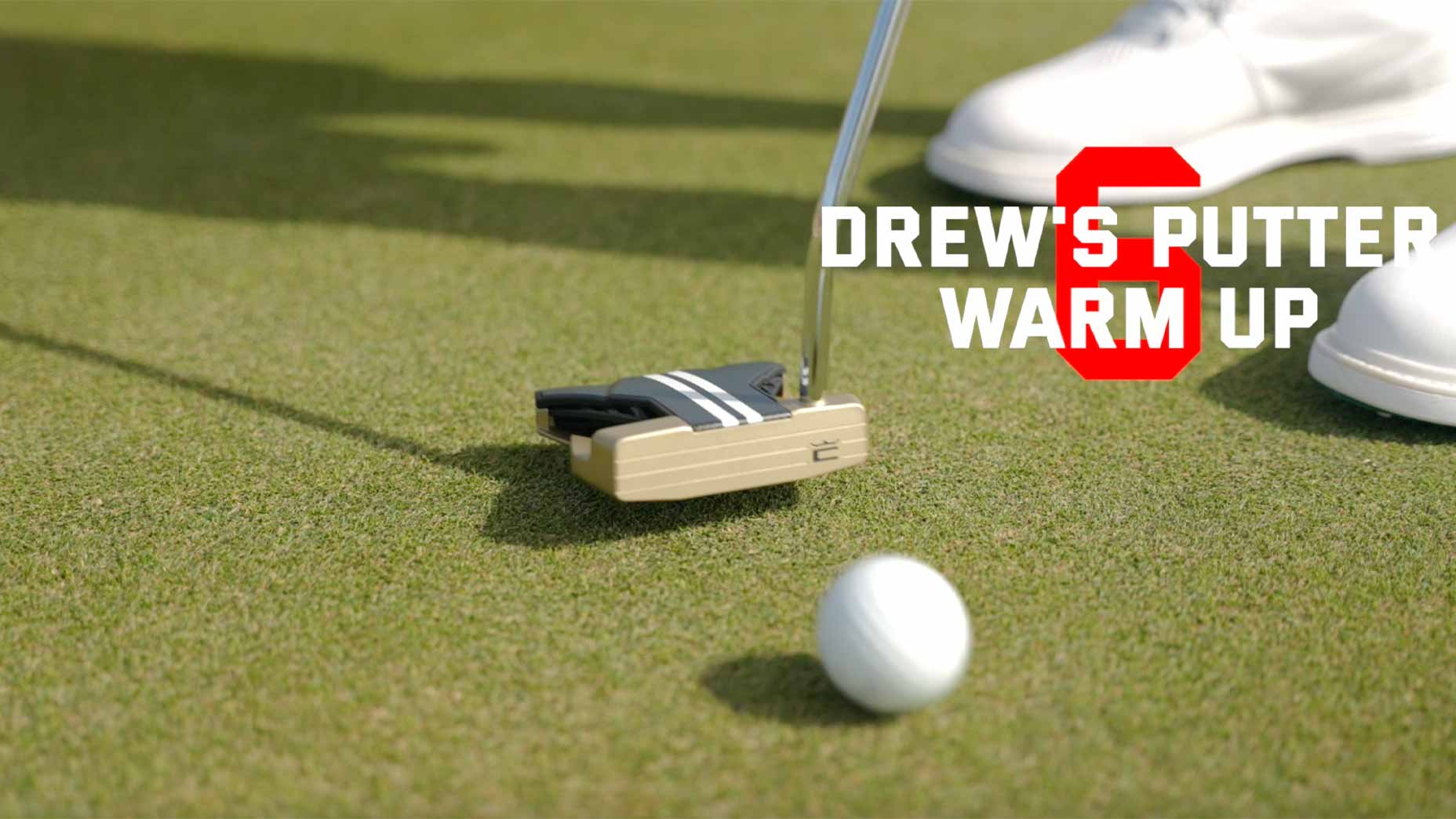
Three-putts are silent scorecard killers. The quickest fix is not better aim — it is better distance control. On long putts, focus entirely on getting the ball within a three-foot circle around the hole. Do not worry about making it. If you can consistently two-putt from 30 feet, you will eliminate several strokes per round almost overnight.
Before each round, spend ten minutes on the practice green rolling long putts. Get a feel for the speed. That brief warm-up is worth more than fifty balls on the range.
Your simple scoring plan
Here is a realistic blueprint for a 97 on a par-72 course:
Target twelve bogeys, four double bogeys, and two pars. That gives you exactly 97. Notice how forgiving this plan is — you are allowed four doubles and you still break 100 comfortably. You do not need to be brilliant. You need to be steady.
To execute this plan, follow three rules on every hole. First, keep the ball in play off the tee. Second, avoid the big miss on approach shots by aiming for the safe part of the green. Third, get your chip or pitch onto the putting surface on the first attempt. If you do those three things consistently, bogey becomes your most common score and double bogey becomes your worst — exactly where you want to be.
The mental game: patience is a skill
Bad holes will happen. You will chunk a chip, thin an iron, or four-putt from twenty feet. When it happens, remind yourself that one bad hole does not ruin a round. A triple bogey on the fifth hole still leaves you thirteen holes to recover. The golfers who break 100 are not the ones who never make mistakes — they are the ones who refuse to let one mistake become three.
After a bad shot, take a breath, accept it, and commit fully to your next one. Golf rewards short memories and steady nerves far more than athletic talent.
You are closer than you think
Breaking 100 does not require a faster swing speed, an expensive fitting, or hours of daily practice. It requires a change in approach — playing the shot you know you can hit rather than the shot you wish you could. Aim for bogey, stay out of trouble, chip it close, and lag your putts. Do that with patience and discipline and you will not just break 100 — you will wonder why it ever seemed so difficult in the first place.
Now go enjoy your round. The best score of your life might be waiting this weekend.