

Why iron play is the true measure of a golfer
Drive for show, putt for dough — you have heard it a thousand times. But somewhere between the tee box and the green lies the discipline that genuinely dictates your scorecard: iron play. The ability to flight the ball with precision, control your distances, and work the ball in both directions is what transforms a recreational golfer into a competitive one. It is also, arguably, the most satisfying skill in the game. There is nothing quite like the sound and feel of a purely struck six-iron that lands pin-high and checks up two feet from the hole.
Yet iron play remains the most misunderstood and under-practiced area of the game for the majority of amateur golfers. They spend hours on the putting green and bang drivers on the range, but rarely dedicate focused time to the craft of hitting irons with intention. Let's change that.
Ball striking: the foundation of everything
Pure ball striking with irons begins with one non-negotiable principle: hitting the ball first, then the turf. Unlike a driver, where you sweep the ball off a tee with a slightly ascending blow, iron play demands a descending strike. The low point of your swing arc must occur after the ball, not behind it.
To achieve this consistently, your weight must favor your lead side at impact. Roughly sixty percent of your pressure should be on your front foot as the clubhead meets the ball. This forward shaft lean compresses the ball against the face, engages the grooves properly, and produces the penetrating trajectory that gives you control over distance and direction.
A common mistake is trying to help the ball into the air. The moment you hang back on your trail foot and scoop at impact, you sacrifice compression and consistency. Trust the loft of the club. A seven-iron has enough loft to get the ball airborne — you do not need to add any. Your job is simply to deliver the clubface squarely and let the engineering of the club do what it was designed to do.
Reading your divots
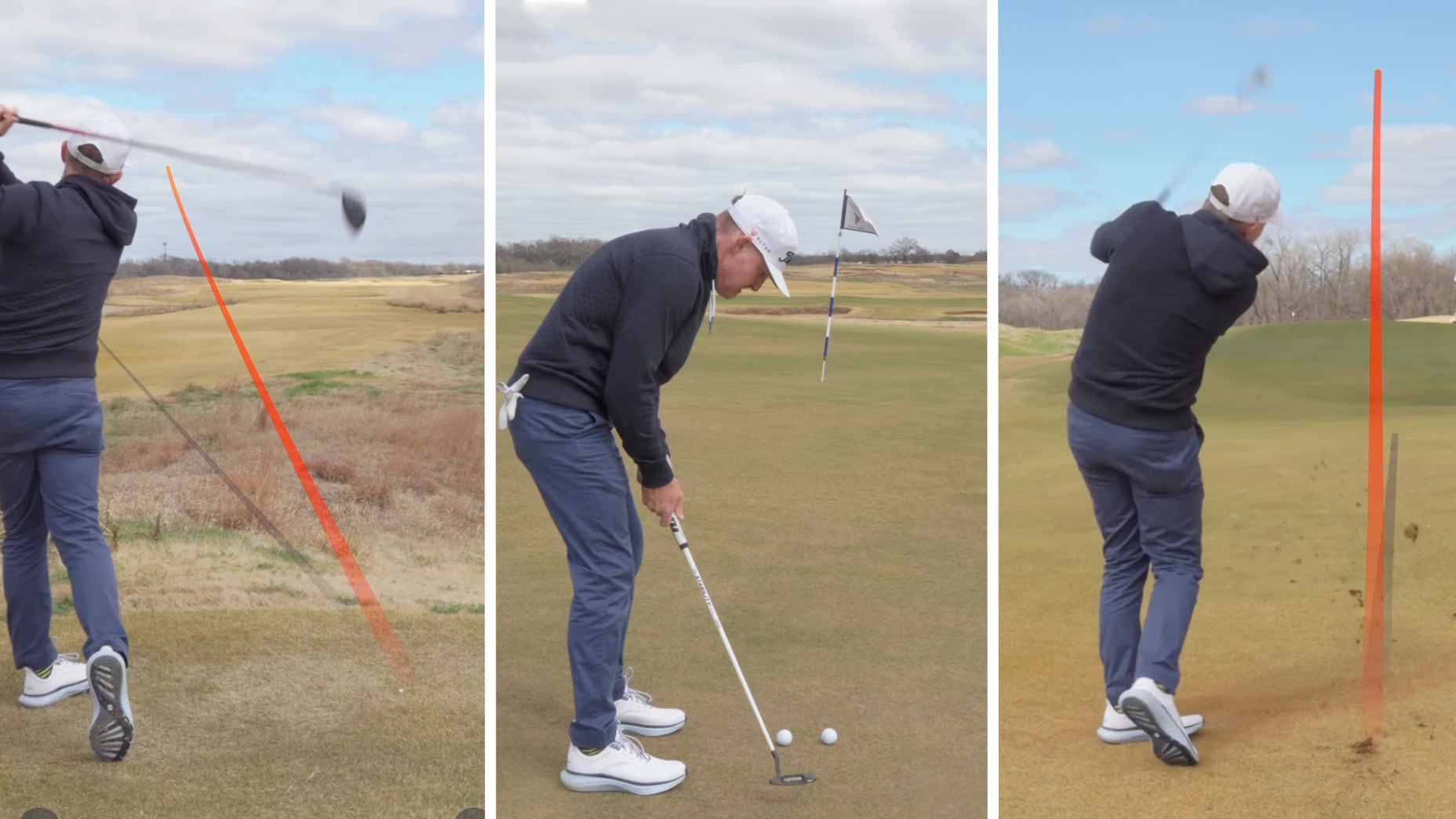
Your divots tell you everything about the quality of your strike. A well-struck iron shot should leave a shallow, rectangular divot that starts at the ball's position or just ahead of it and points along your target line. If your divots are deep and gouging, you are likely steepening your angle of attack too aggressively. If there is no divot at all with your mid-irons, you may be bottoming out too early.
Pay attention to the direction as well. A divot pointing left of target for a right-handed golfer suggests an over-the-top move and a likely fade or slice. One that points well right of target might indicate an excessively in-to-out path. Neither is inherently wrong — some elite players prefer one shape — but your divot direction should match your intended ball flight. If it does not, the ground is giving you honest feedback that no launch monitor can replace.
Distance control: the scoring skill
Hitting greens in regulation is a distance control exercise far more than it is a direction exercise. Most greens are wider than they are deep, which means front-to-back misses hurt you more than left-to-right ones. Knowing exactly how far you carry each iron — not total distance, but carry distance — is essential.
Spend time on the range with a reliable distance-measuring device and chart your carry numbers for every iron in the bag. Be honest. The number that matters is the one you produce on average, not the one from your best swing of the day. Most amateurs overestimate their iron distances by at least one club, and that ego-driven club selection leads to countless short-sided misses.
Once you know your numbers, factor in conditions. Altitude, temperature, humidity, and wind all influence carry. A ball will fly measurably farther in warm, humid air at elevation than it will on a cold, dry morning at sea level. Building an awareness of these variables and adjusting your club selection accordingly is what separates players who hit greens from those who are always scrambling.
Shot shaping: expanding your toolkit
The ability to move the ball intentionally in both directions is a powerful weapon, particularly on courses with doglegs, tucked pins, and crosswinds. At its simplest, shot shaping comes down to the relationship between your clubface angle and your swing path at impact.
For a controlled fade, set your clubface slightly open relative to your swing path. The ball will start in the direction of your path and curve toward where the face is pointing. For a draw, close the face slightly relative to your path. The key word in both cases is slightly. Amateurs tend to exaggerate these adjustments and produce wild hooks or banana slices instead of workable shapes.
A practical approach is to make your setup do most of the work. For a fade, align your feet and shoulders a few degrees left of target, keep the clubface aimed at the target, and swing along your body line. For a draw, reverse the process. This method requires minimal swing manipulation and produces reliable, repeatable results under pressure.
When to shape and when to play straight
Not every shot demands shaping. In fact, your default should be a stock shot — the one shape you hit most consistently under pressure. Save the intentional curves for situations that clearly call for them: wrapping a shot around a tree, chasing a pin cut behind a bunker, or riding a crosswind. Over-shaping is a trap that leads to compounding errors and inflated scores.
Playing iron shots in the wind
Wind transforms iron play from a one-dimensional exercise into a chess match. The first rule is to accept that the wind is going to affect your ball and to work with it rather than against it. Fighting a headwind by swinging harder produces more spin, sends the ball higher, and actually amplifies the wind's effect. This is the opposite of what you want.
Into a headwind, take more club — sometimes two or three more — and make a controlled, three-quarter swing. Position the ball slightly back in your stance to lower the launch angle and reduce spin. The result is a boring, penetrating flight that holds its line and loses far less distance than an aggressive full swing.
Downwind shots require the opposite adjustment. Club down and allow for additional roll. Crosswinds demand a decision: do you aim into the wind and let it bring the ball back, or do you shape the ball into the wind to hold the line? Both strategies work, but aiming into the wind and letting it do the work is generally the safer play, as it requires less manipulation and is more forgiving of slight misses.
Club selection: thinking beyond the yardage
Smart club selection involves far more than matching a number on a rangefinder to a number on a club. Consider the lie, the elevation change, the pin position, the trouble around the green, and the shot you are most likely to execute well under the current circumstances.
If the pin is back and the green slopes away from you, an extra club with a softer swing might land the ball gently and give you a better chance than hammering a shorter iron and watching it release over the back. If there is water fronting the green, take the club that ensures you carry the hazard even on a slight miss-hit. If you are stuck between clubs, choose the longer one and swing easy — a smooth eight-iron is far more reliable than a hard nine-iron.
Great iron play is ultimately about making smart decisions and executing simple fundamentals repeatedly. It is not glamorous. It does not generate the social media highlights that a towering drive does. But it is where the game is won and lost, and golfers who commit to mastering their irons will see their scores drop faster than through any other avenue of improvement. The irons are your scoring tools — treat them with the respect and practice time they deserve.